
My community for my Journal 7 was my hometown of Topsham, ME. The technologies that I felt had the most noticeable impact on my community of choice were Facebook / Facebook Marketplace, and the numerous amount of old, local Saw/Paper Mills. The tech footprints are a little complicated when viewing these technologies, so I decided that it would be appropriate to discuss these things from a slightly different view. For Facebook, I’ll discuss the footprint of the iPhone, since this is the most common device used to use the app. For Saw/Paper Mills, I decided to research the negative effects that these mills give off to local communities.
FOOTPRINTS
iPhones: By researching the subject, I came to the conclusion that there are three main ways that smartphones impact the environment: the CO2 emissions emitted from the production of each piece of the iPhone, the environmental damage produced from rare earth element mining, and e-waste. I couldn’t go around to everyone in my town and ask them if they owned an iPhone or if they used Facebook, so I had to do some math and estimate around how many citizens of Topsham own iPhones. I took the total population of Topsham, ME (8,778, via http://worldpopulationreview.com ) and multiplied by the percentage of Americans who own iPhones which as of right now is about 43%. From this, we get approximately 3,775 iPhone users within my hometown of Topsham. First, we’ll take a look at the overall emissions from each iPhone.
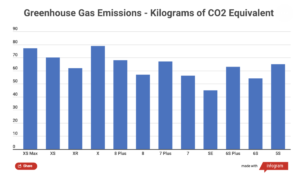
As of writing this project, the photo inserted above is rather blurry, my apologies but there was a conflict with uploading to the media library, so I’ll explain it. The x-axis from left to right goes from the iPhone XS Max to the iPhone 5s. Since there’s no way to see which model the estimated amount of users are using, I decided to take the average of the graph:
79 (CO2 Emissions from the iPhone X in kg) + 45 (CO2 Emissions from the iPhone SE in kg) = 124 / 2 = 62 kg of CO2 Emissions.
However, these are for the lowest memory options of each iteration. The biggest surprise about the iPhone CO2 emissions is the increase in emissions as the storage of the device increases. For example, the iPhone 8 with 64 GB of storage generates about 57 kg, meanwhile the iPhone 8 with 256 GB of storage generates a whopping 81 kg of emissions, which is a 42% increase in CO2 emissions for about 200 GB of storage. When we take into account the different storage options and crunch some numbers, the average CO2 emissions from the iPhone are about 80 kg of CO2 emissions (via getorchard.com). Finally, if we take this average and multiply it by the estimated amount of iPhones in Topsham, my town’s iPhones make up about 302,000 kg of CO2. Wow. Prior to this research, I wouldn’t have ever thought that my small rural town could come anywhere close to producing that much emissions from our phones.

source: https://www.mining.com/apple-to-include-parts-made-of-100-recycled-rare-earths-in-new-iphones/
The diagram above shows the common rare earth metals found in smartphones. There are a ton of these elements in iPhones, so I decided to focus on the rarer, but also the most useful contributors to the features of the iPhone: (neodymium, praseodymium, and dysprosium). These rare earth metals are responsible for speakers, cameras, and touchscreens. While these elements are very rare, they are also very difficult to mine. So what’s the worst part about these rare earth metals you ask? Well since these are so difficult to mine and so rare, that means that they are basically impossible to recycle, as of right now. From my research, it seems that these elements used to be mined across North America, but the mines were closed due to environmental concerns. So now the majority of the mining takes place in pit mines in China, which has lead to a dangerous environmental. According to Johnathan Kaiman from The Guardian, the dangerous part of this mining stems from the processing of these rare earths.
“Their ore is often laced with radioactive materials such as thorium, and separating the wheat from the chaff requires huge amounts of carcinogenic toxins – sulphates, ammonia and hydrochloric acid. Processing one ton of rare earths produces 2,000 tons of toxic waste” (Kaiman).
Lastly, we have the eWaste produced from upgrading our iPhones all the time. With the advances in technology, eWaste is increasingly becoming a bigger and bigger issue across the world. It is now the world’s fastest-growing type of waste. According to The Global E-waste Monitor 2017, roughly about 6 kilos of eWaste is produced for every human alive. If we apply this number to the population of my community, the town of Topsham produces about 22,650 kilos of eWaste. In North America, only about 20% of eWaste is properly recycled, which means that Topsham produces about 18,120 kilos of unrecycled eWaste. Yikes. So let’s take a look and see what potentially happens to the rest of this eWaste.
- Best case: you’re like us and store most of your eWaste at home in a box or drawer of used electronics. Not the tidiest solution, but it’ll do for now.
- Medium case: the devices are mixed in with garbage, end up in landfills where the toxic materials leach into the environment.
- Worst case: this waste winds up in the third world, where the world’s poor wind up harvesting it in incredibly unsafe conditions in order to recover the tiny amounts of precious materials in these electronics (As seen in the report on the eWaste problem in Ghana)
source: (https://maineanencyclopedia.com/wp-content/uploads/topmill1-Copy.jpg)
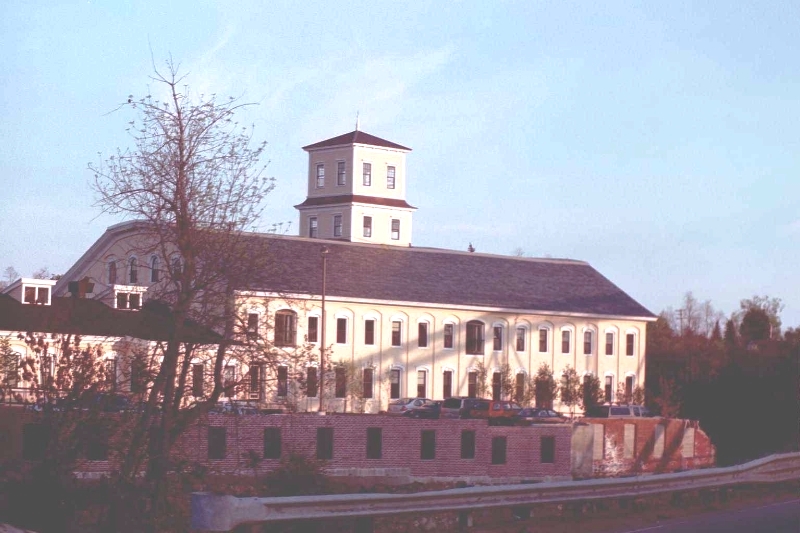
Saw/Paper Mills: From my research, I found that the impacts on human health stemming from Saw/Paper Mills depends on the type of wood being processed. For example, the wood dust from some tree species has a more serious potential impact than others, the dust from hardwoods (oak, mahogany, etc) seems to have the most impact on the air quality of the local communities (www.westerncape.gov.za). Thankfully, the effects of this processing depends on how properly the dust and other byproducts are managed. However, if improperly managed, the wood residue and contaminate water and destroy habitats. When this residue is inhaled, it may cause asthma, irritation, allergic reactions, and “nasopharyngeal cancer” (www.westerncape.gov.za). While the community has to primarily only worry about the management of wood residue and its impacts on the environment, the real people at risk are the workers who deal with the direct inhalation of this residue.

source: https://static.businessinsider.com/image/5aec256119ee8633008b4d34.jpg
IMPACTS
Well since the Saw/Paper Mills are in my community, I don’t feel the need to discuss how they would affect my community since I would just be reiterating myself from the last paragraph. However, if the iPhone is an interesting piece of technology to consider. Well if iPhones were produced in Topsham, there would be more jobs for the citizens of Topsham, and like I said in Journal 7, I believe that my town is looking for ways to strengthen our economy. As my community stands as of right now, there is a subtle emphasis on increasing the population of our town so we can one day become a bustling city instead of just a small town, so I’m sure if iPhones were produced locally, it would aid in the effort do become more of a city.
As for the negative effects, Business Insider observed the place where about half the world’s iPhones are made, Zhengzhou, China. I hate to come off as lazy, but I believe it is acceptable to directly quote the main findings of the residential life of this “iPhone City” that they found.
- “Thousands of residents’ livelihoods rely on the success of Apple and Foxconn, though they don’t even work at the companies.”
- “We spent the day with a 31-year-old woman whose entire life has been shaped by Foxconn and Apple, having worked at the Foxconn’s Shenzhen factory in her 20s and then moved to Zhengzhou to open her own business catering to factory workers.”
- “She told us that the lives of ex-factory workers like herself, who open businesses when they save enough money, is often harder than that of the factory workers. Her life is better now than when she was growing up, but she sees little opportunity to escape the grinding lifestyle she currently lives.”
Apparently, having an iPhone factory in your backyard means that you basically work for Apple. With the worker population of this one major factory alone being about 350,000 people, the factory became the main source of income for everyone in the town, which lead to other businesses shutting down due to the fierce competition that is the powerhouse of Apple. In 2008, The New York Times described the province as one untouched by China’s boom, where people are too poor to heat their homes in winter or have running water, and mobile phones are an “impossible luxury” (Business Insider). Apparently, along with the environmental impacts, the mental health of the workers is very low. to the point where there was a wave of suicides among factory workers from 2010-2011. A lot of people moved to the city to either work in the factory or work around it and open a small business since the population was increasing extremely significantly. One of the workers Business Insider interviewed was a woman factory worker named Liu. Liu has found that, for her family, there is no way out of the grinding poverty that has marked her life both as a factory worker and a restaurant owner. Apparently Liu’s livelihood, like that of all iPhone City residents, is subject to the choices of Apple and Foxconn, along with the local government. This means that the entire livelihoods could disappear without warning. The last thing to consider about these factories with their state of the art technology is that they provide a ton of jobs for the citizens around them, but what happens when these factories become mostly automated, which could very well be the case in the near future. Not only will the factory workers lose their livelihood, but instead a majority of the citizens of the towns and cities around the factory. Moral of the story, the cons would significantly outweigh the pros, I really hope there’s never an iPhone factory in my backyard.
DECISIONS
Overall as technology stands as of right now, I believe that there should be some sort of ethics committee when it comes to these technologies. I understand doing something and not knowing the effects or consequences of your decision, but once you do understand whats going on, and you realize that it’s not good for the environment and/or the health of the people; I think corporations should be suspended until they figure out ways to safely go about their businesses and productions. The goal shouldn’t just be to reduce the ecological footprint of a certain technology. The goal should be to eliminate any footprint, so that future generations have a planet to live on.
References / Works Cited:
https://www.businessinsider.com/china-iphone-city-residents-foxconn-apple-effect-2018-5
(https://maineanencyclopedia.com/topsham/)
https://www.theguardian.com/sustainable-business/rare-earth-mining-china-social-environmental-costs
http://worldpopulationreview.com/us-cities/topsham-me-population/
https://www.worldometers.info/world-population/us-population/
https://www.digitaltrends.com/mobile/iphone-use-teens-2018/
(https://www.getorchard.com/blog/environmental-impact-of-the-iphone/)
You must be logged in to post a comment.