A community I really value is Greek Life at the University of Maine. I am a member of the Tau Kappa Epsilon Fraternity on this campus, but beyond my own frat, there are a couple of dozen other greek organizations on this campus. While there has always been a friendly rivalry between these different organizations, the inter-fraternal relations are strong and there is a bond between us that is very important. We all have the same set of values at our core; to help each other be better individuals and stronger leaders for the future. Executions will always differ between organizations, but this primary goal of self and mutual betterment is something that I value greatly, as it is something that very few other collegiate programs can offer. To lose this sense of brother and sisterhood, the lifeblood of our organizations would be a true travesty. Having such a strong bond and connection with those closest to you on a level that goes beyond friendship is something that would not just change what greek life would be, but would change the fabric of the college social experience. For these reasons, the Greek Life community at the University of Maine has enormous potential and is something I view as an integral part of my college experience.
Within my specific fraternity, we have 30-ish active brothers at any one time. In order to keep in touch with all these brothers and keep them updated on events, policies, and general information, we use Slack. Slack is an internet-based business management tool that is widely used in tech fields and small business sectors around the world. This application helps groups of people stay organized, stay up to date, and plan effectively. This application has no ads, does not accumulate private data, and functions in the least centralized way possible for such an application.
Any real footprint that this application would have would be the power consumption used to run the servers and run the mobile devices running the client-side. In the state of Maine, we are lucky enough to have a growing renewable source of the power of sector, however, I can imagine how such applications as this would be less than environmentally conscious in other countries where the primary producer of electricity is coal or fuel-based. The servers will consume the most amount of energy at any given time, but thanks to the quick adoption to cheap solar energy that has been heavily subsidized by the US government, Silicone Valley as a whole has begun to move closer to a more eco-conscious mindset when it comes to data management. Besides that, Slack does not intrinsically have any other environmental footprint. As for the mental health of the users, slack is very respectful and mindful of this, as its place on mobile devices is non-intrusive and only notifies you if absolutely necessary. The only other technology that TKE uses would be the appliances that are in the house. While I would gladly keep the CFL and LED lightbulbs that keep the house lit, there are certain technologies in the house that I would change if I could.
Incandescent lightbulbs, being still one of the cheapest options, are still widely used in my Fraternity. There have been moves to replace them, but their usage demands a constant waste of energy in the form of heat. Speaking of heat, TKE uses oil to heat the massive house. This practice, again, is hardly eco-conscious, as the oil industry has destroyed ecosystems and is on its way out as it is. Oil is produced at a drastically slower rate than it is consumed so it is only a matter of time before it is at a premium compared to gold or platinum. These two, more primitive technologies used every day are things I would love to change. For starters, using natural gas, or more eco-minded methods of heating our house would be fantastic. The impact om the environment on our house alone would be staggering. However, considering the costs of renovation to replace the outdated oil system is far outside the budget of what TKE can afford. That being said, I would love to ban oil, but economically, in a place like Orono Maine, it can be hard to put money towards more eco-conscious methods when the wallet is the largest concern. Of course, small things like old-fashioned lightbulbs and single-use plastics are things that I would love to ban. All of that takes time and convincing, but I can imagine that I would really make an impact on my community for the better.
I believe that ethical decisions should be made based on the ethics themselves. If it is a decision like vaccination, that affects everyone, it should be something decided by a nation. Whereas if it is a decision about smartphone use, that should be deemed by the family, in the home. Again, it really depends.
When it comes to my frats specific tech usage, the majority of it comes back to one basic requirement that is more or less unwritten: smartphones. While there has never been a rule that a brother has to be online and ready to respond at all times, it is something that has become more and more important as the years go on. While once, everything you needed to know as a frat brother was things you could just write down at a weekly meeting, the luxury of the internet has enabled us to be constantly connected and interacting with each other. As a result, every single brother in my frat has a smartphone with the slack app installed. For the remainder of this project, I will be focusing on the ecological impact of the iPhone, which would make Slack useless without it.
As for smartphones, the majority of our brothers have iPhones. After talking around with many of them, it seems that most of the iPhones owned were bought new, on average about 3-4 years ago. While the environmental, political and social impacts of the iPhone and its manufacturing are dense and expansive, I will focus first on the elements contained in these iPhones.

Each iPhone owned by the brothers in my community consists of the enrichment and further manufacturing of at least 80 different elements, accumulated from all over the Earth. From Lithium mines in South America to Gold mines in Africa, the required, basic elements that go into the production of iPhones is without a doubt complicated. Considering the iPhone is essentially just a computer, one of the most abundant elements in its manufacturing would be Silicon; ranging in use from its CPU to its screen, this element is vital to its production. The vast majority of Silicon comes from mines in China, on average exporting 4,600 tonnes of it per year. All of these elements are eventually shipped, smelted, refined, and assembled into the basic components that later find their way into the final assembly at Foxconn in China. Often, components will go on great journeys from country to country, only to find themselves returning back to the country of origin in the final step. This constant, systematic shipment of materials all over the globe, for the purpose of building the iPhone, winds up consuming more oil and fuel, as a result, every year, as consumption continues to grow. The iPhone also contains many contentious elements such as Antimony, which has historically caused political unrest. While Apple has taken great lengths to ensure their materials are not costing the lives of other humans, the truth is that tracing the origin of many of these elements can be next to impossible. While many of Apple’s suppliers are listed every year in an internal report, much of these sources are simply the final hands in a long chain of commerce.
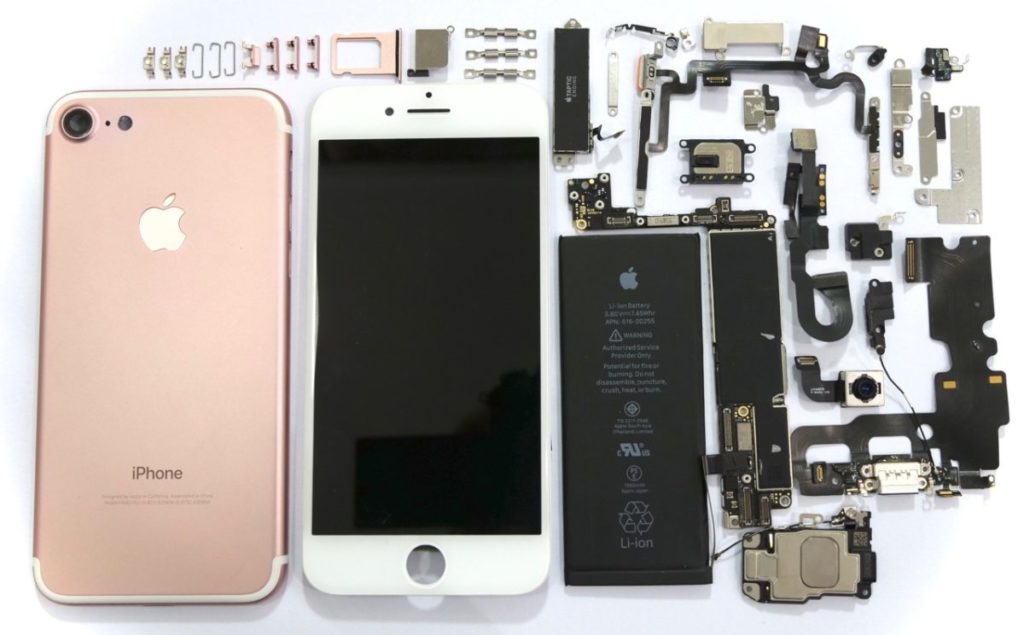
When an iPhone eventually comes to the end of its life, a good number of them actually wind up finding their way into our drawers. For many Americans, devices become obsolete, and their final resting places wind up being tucked away under years of junk in our home kitchens. However, for many Americans, it is actually financially responsible to trade in their old iPhones in order to get part of the cost of their new one knocked off. This is an option I have actually used quite a few times and it really can save people money. After Apple takes these old and often broken phones back into their supply, they are often refurbished with replacement parts and resold at a reduced cost. While this process of reuse is fantastic and can last for quite a long time, reports of planned obsolescence as uncovered by an internal investigation shows that iPhones are simply not designed to last forever. Eventually, the software outpaces the old hardware, or certain components just aren’t produced by Apple anymore. At this point, Apple will often run a silent end-of-life campaign, where any bought back iPhones are disassembled, and many of the parts are put into a recycling unit for use in other electronics that can still make use of the older metals and materials. The sad part of this comes with the reality around the screens and batteries, which contain metals and other elements that are either too interwoven or too toxic to be recycled. While Apple has been better in recent years about the proper disposal of these parts, other companies have been less than eco-minded. It is extremely common for other tech companies to hand off their e-waste to third party companies. Many of these companies wind up dumping much of this waste in African Countries and marking the shipments as “donations”. That is where many devices meet their end; burning at the edges of rivers in small villages, being picked apart of any morcels of copper that can be found.
If such end-of-life dumping were to take place at our own front steps, I think that the outrage would be deafening. Buring plastic and toxic heavy metals, spiraling around our airways every day would surely cause enough of a disturbance to cause widespread protests from both my own brothers, but also that of the entire community. Philosophically, it is interesting to remember that the difference is only based on the line of sight. If the problem is literally on the other side of the world, many people simply forget that it exists. Move these problems to our very own neighborhoods, and suddenly it is the most pressing issue in the world. This is the trouble with a lot of the consumerist mindsets that comes with being an American. Yes, the new iPhone is a fantastic piece of tech that has changed the lives of so many people for the better, but because it is so hard to think globally, about all people affected by these products, it can be easy to forget the people who suffer from our consumption.
Interestingly, this process can actually be altered slightly. Third-party manufacturers have begun to sell off-brand parts to repair centers to rebuild broken iPhones. For many, this option is much better than going out and buying a new iPhone when their current one breaks. Rather than getting rid of the entire phone, where most of the components are still perfectly functional, someone can just get rid of the broken part (usually the screen). The brothers in my frat have actually been quite conscious of this in recent years, but there is much that can be changed and improved.
Moving forward, I think that the improvement of this technology is not only important but is quite vital. At a certain point, when we out use and overproduce our natural resources to total depletion, the iPhone will go from a product as common as water, to a commodity that only the super-rich will be able to afford. The same is the direction oil is going in. At the rate that humans consume oil, compared to the shocking slow rate it is produced, it should come as no surprise that someday we will run out. I have actually talked to my parents about this and they both are so locked into their own respective mindsets, that it should come as no surprise that they brushed all of this off as alarmist nonsense.
I am then reminded that one of the primary elements needed for the function of MRI machines is helium; an element that we use thousands of cubic meters of every day in America on party balloons alone. Someday we will run out of these things, and like the iPhone, we will wonder why we wasted the earth’s resources on what we could live without.
You must be logged in to post a comment.