Brett Smith
NMD 200-Project 1
Oct. 4 2019
Phone Addiction
What is one thing you do too much? Would using your phone be on the list? One of my biggest pet peeves is trying to have a conversation with someone who is preoccupied with looking at their phone. Living in the moment can be hard for most frequent smartphone users. Whenever there is a dull moment or a lack of interest, the phone comes out, and the head goes down. Phones have become more than a resource, they have become a connection, a bond. From lifelong observation, I can say the majority of teens have their phones within three feet of them at all times. One of the problems is that a smartphone is more than a phone, it’s a swiss army knife with multiple tools and resources. A phone serves more than one function or purpose, which is what makes it so attractive. From my perspective, I am looking for a way to break this habit and better train myself to know when to use my phone less. To become less phone-dependent. In this paper, I will be discussing the negative side effects of phone addiction, a new design that could possibly fix it, and what I think could make it even better.
Phone addiction does not stem from the phone itself. Users are not addicted to the physical properties of the phone, but rather what it displays. Smartphones have the ability to use social media apps such as Instagram, Snapchat, and Twitter just to name a few. Social media provides a love-hate relationship for its users. Everyone loves to post things about themselves and receive amazing comments and tons of likes which boosts their self-esteem, but everyone hates to see amazing pictures of what their friends were doing over spring break on the trip they were not invited to. It is a very confusing system that somehow leaves the user coming back for more. When I look around in the cafeteria or any other public space, I see a lot of phones out, heads down, and it sounds relatively quiet. It seems like everyone is so interested in what’s on their phones when what is really going on is what’s happening around them. Using a phone for a social separation is not a healthy habit to have. According to Kim Williamson, “the ability to read cues like tone, body language, and facial expressions… Email and texts don’t convey empathy, tone or subtext the way face-to-face or phone conversations do” (Williamson, “5 Ways Technology Has Negatively Affected Families”). The generation that doesn’t know what life was like before computers and the internet are at risk of losing the ability to have meaningful conversations. Living in the present can be hard when there is so much going on in your mind and on your phone. Phones have become an extension of the user. Social media allows the user to create the perfect version of themselves, only posting their best pictures from the right angles, a side others might not see in real life. Taking this to the living room, when my friends and I are watching TV, they will also be on their phones. This makes me feel as though I’m a bad host and that they aren’t satisfied with the current situation. Personally, I think using a phone in front of someone else, unless there is a real purpose, is rude and disrespectful. However, so many people are hooked on their phones that they subconsciously grab it and check for messages without even realizing it. I have also seen people’s fingers swipe across the home screen multiple times just because they are bored, aimlessly looking for something to do or for an app to catch their attention. The problem is not my friends and their phones, it is when they decide to use their phones and what purpose it is serving them at the time. Social media is a great tool when used properly, but it can also be a weapon.
Every like or loud notification the user sees, a small dose of dopamine gets released from the brain. This makes the user feel good and rewarded. Dopamine provides the fuel to keep the addiction fire burning, the reason people keep coming back for more. There is a certain level of satisfaction that you feel from receiving that like, or seeing how many followers you have. Life is a movie and if feels good to be the main actor every now and then. We are living in a self-centered world that is all about self-promotion. This helps people get jobs by making connections and becoming recognizable as their own brand. If you do not love yourself and show why you are so great, you do not belong in this world. That is the effect that social media can have on some people and its side effects have been characterized through depression. “Smartphones were introduced in 2007, and by 2015, 92% of teens and young adults owned a smartphone. The rise in depressive symptoms correlates with smartphone adoption during that period, even when matched year by year” (Miller, “Does Social Media Cause Depression?”). There is a strong correlation between the use of cell phones and depression rates. There is causation between using social media and being depressed. One backfire that these social media companies did not consider was the side effects of using too much social media. The goal of these companies is to attract your attention for the most amount of time possible. The more time you spend on their apps, the more money they make. Like anything, too much of one thing isn’t good. Social media does have a lot of pros, but as stated earlier, it also has a lot of cons. It is just one of the tools in the swiss army knife, the hard part is just knowing when to use it.
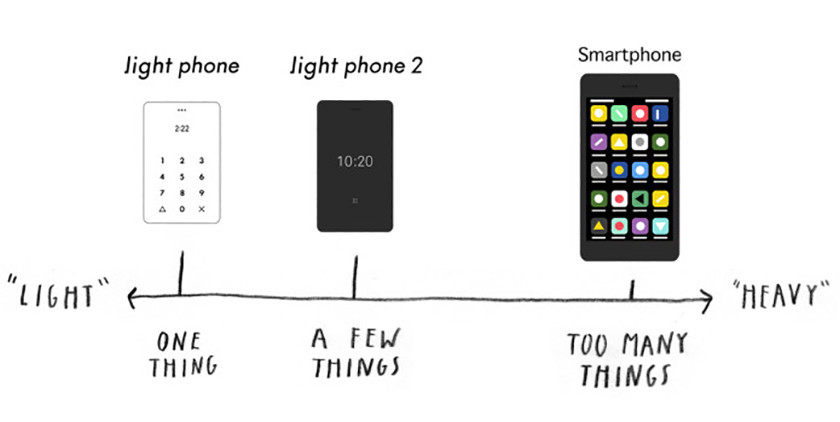
When thinking about redesigning phone addiction, there is one source that comes to mind immediately. There is this company based out of Brooklyn, NY I found about a year ago on Indiegogo. Their slogan is, “A phone that actually respects you” (Light, “Light Phone 2”). They are a phone production company whose goal is to make a simplified phone that only gives you what you need, without all the other stuff. It is designed to be used as little as possible, giving the user the ability to break the bond with their phone. From their website, it says “A phone is a tool, and it should serve you as the user, not the other way around” (“The Light Phone.”). Like everybody, I often feel attached to my phone in times when I don’t want to be. This phone redesign will hopefully make the user less attracted to using their phones when they shouldn’t be. According to Indiegogo, they have $3,514,148 by 10,733 backers, which means there are a lot of other people who feel the same way. People are tired of being attached to their phones, they want to start living lives handsfree, without having a phone in their hands all the time. Although it could be if you wanted it to, this phone is not designed to be used all the time or as a substitute for the current smartphone you already have. Rather, its purpose is to take only what you need, important contacts, maybe some directions or a ride sharing app, giving you the ability to leave all the other stuff behind. Everything from its textured E-Ink display (no bright led backlit display), to its credit card-sized small design, is designed to only be used when it has to be. Its goal is to attract the least amount of attention as possible. An example of when this would be helpful is going to dinner with your friends. Instead of bringing everything with you (your current smartphone which you know is distracting because of its social media capabilities) you might decide to take your Light Phone instead. This would limit the usage of your phone only using it when you have to and not when you’re bored. I personally really like the idea of this. I’ve been waiting for something like this for quite some time and I am excited that it is finally here. Without feeling obligated and socially disconnected from not being able to use social media, you can have the option and the choice to feel independent when you want, having the ability to take that break from your device. The phone’s website puts it nicely by saying, “The Light Phone II will never have feeds, social media, advertisements, news or email. All of the tools are custom-designed for our Light OS. There is no infinity, just intention” (“The Light Phone.”). There is nothing worse than wasting time endlessly scrolling through social media or unread emails. With the Light Phone, the only tools you have are what you need, phone, settings, alarm clock, calculator, some songs, notes, and finding a taxi, all of which can be added or removed. On paper, this sounds like the dream phone for many people.
Previously, Light Phone released its first phone, the Light Phone, through Kickstarter in 2017. Intended for a larger, more general audience, the Light Phone 2 was designed to meet some but not all of the needs that a common smartphone is able to provide. The majority of critics have a hard time justifying buying a second phone that does less than the phone they already have. Understanding this perspective, it is not as easy as it seems. From personal experience, I have deleted social media, safari, and other unneeded apps from my phone that I thought were too distracting but eventually had to redownload them for other situations that came into my life. The majority of people, like me, don’t have the self-control to delete an app and keep it deleted even though all the inconvenience that it might create. As for the price, not everyone has an extra $350 to invest in a secondary phone to only use a handful of times. From a potential investor’s perspective, unless you are looking to transition to using a “dumber” phone full time, I would not suggest buying this product. Before becoming repetitive, this phone is meant to completely cut off your phone addiction, because there is nothing addictive about it.
When trying to redesign a product like this, it can be challenging to find a way to make it better. There is not much I could add to the design because its goal is to be as minimalistic as possible, without being in the way. However, one thing I would add is spell check and autocorrect. According to a review by Roy Germano from YouTube, it does not have auto correct, so you have to be extra careful when typing messages as it does not have a thumb-friendly design (Germano, “Review of the New Light Phone 2…” ). As of now, the phone is only available in two colors, black and white. This makes sense as it matches the business model for being straight forward and only having what you need, is very black and white. The challenge with this is taking a design that is already so simple and intuitive, and trying to get enough of the consumer’s attention to make them want to buy and potentially use their product more than their current smartphone. Some of the phone’s attractive features can be connected to Johann Hari’s list of lost connections. The list includes the bare human necessities we need to live a healthy life, community, meaningful values, meaningful work, interaction with the natural world, respect for who you are and what you do, access to a secure future, and healing from past violence. I am also going to add the need for health and physical pleasure as well as time management to this list. Only touching on a few, having a community is essential for building relationships and feeling a sense of belonging. Sharing Family meals at the dinner table, connecting and bonding with other people are all part of being human. Being able to find connections and people that actually respect you, like the Light Phone. Social media individualizes its users because the majority are self-promoting, extracting themselves from their community, being a problem the Light Phone hopes to fix. Having meaningful values means respecting yourself and your culture, something only you know without feeling the need to share it with the world. Seeing other people’s values on social media might not be the same as yours, but that’s okay, as long as you are not tainted by their beliefs. Interacting with the natural world and becoming engaged not with your phone, but with the people and conversations happening around you. Staying physically active without needing your watch to tell you when to workout and get off the couch, as well as setting aside time. Giving yourself enough time throughout the day to just sit and breathe and connect with yourself.
When dealing with phone addiction, it is all in the hands of the user. It is up to them to find their values and know what keeps them happy. The problem is not the phone, it is our addictive and self-centeredness that fuels social media which leads to depression through the use of a phone. Phones are a tool, we just have to know when and how to use them. My redesign comes from within, being able to admit the addiction and knowing how to reconnect with yourself.
References
Germano, Roy. “Review of the New Light Phone 2 (and Why I Don’t Use a Smartphone).” YouTube, YouTube, 20 Sept. 2019, https://www.youtube.com/watch?v=6NoUCGTbp9I.
Light, Phone. “Light Phone 2.” Indiegogo. N.p., 26 Feb. 2018. Web. 26 Sept. 2019. <https://www.indiegogo.com/projects/light-phone-2#/>.
Miller, Caroline, and Child Mind Institute. “Does Social Media Cause Depression?” Child Mind Institute. N.p., n.d. Web. 26 Sept. 2019. <https://childmind.org/article/is-social-media-use-causing-depression/>.
“The Light Phone.” The Light Phone. N.p., n.d. Web. 26 Sept. 2019. <https://www.thelightphone.com/>.
Williamson, Kim. “5 Ways Technology Has Negatively Affected Families.” HowStuffWorks. HowStuffWorks, 06 Mar. 2012. Web. 26 Sept. 2019. <https://electronics.howstuffworks.com/family-tech/tech-effects-on-family/5-ways-technology-has-negatively-affected-families3.htm>.
I just realized the 2 pictures I had in the google docs, where I originally typed it, did not transfer over.