
Building New Franchise Buildings vs Inhabiting Old Buildings
Project 2, By Claudio VanDuijn
For project 2 I decided to look at franchises as a new technology. Franchises like McDonalds, DunkinDonuts, and BurgerKing, thrive on the model of building cheap and dirty, using single-use products and pushing only for profits. Today I will look at how these franchises can move into small towns while avoiding disruption the town aesthetic, and maintaining a low environmental impact.
The product life cycle worksheet below has been adapted for the new construction of a franchise building. I included things like new lumber, fasteners and other building materials. I also included single-use products, such as plastic cups, straws, and napkins. The goal here is to find a way to create a franchise with minimal waste, and disruption to small-town aesthetics.
Here is the Life Cycle Assesment on building a new franchise vs renovating an old building: READ HERE
Through this process, I found that the major environmental impacts come from the actual construction of building a new building, as well as the single-use products the businesses use in everyday commerce. The overall life cycle score for the current method of construction and single-use products was 131 points. After making the following improvements I was able to drop that score down to 51 points!
Improvement analysis
What could you change in your product to improve its impact on the environment? Describe your improvements here.
- Instead of making new buildings we could renovate existing buildings in the town, this would cut down drastically on the amount of wasteful materials used. The cost and time needed to renovate an existing building is drastically lower than the requirements for making an entirely new building.
- We could also eliminate plastics all together from the business. Instead of plastic cups, straws and other wasteful materials, we could use Bio-degradable paper cups and straws. This further helps to cut the environmental impact, drastically improving the companies ecological footprint.
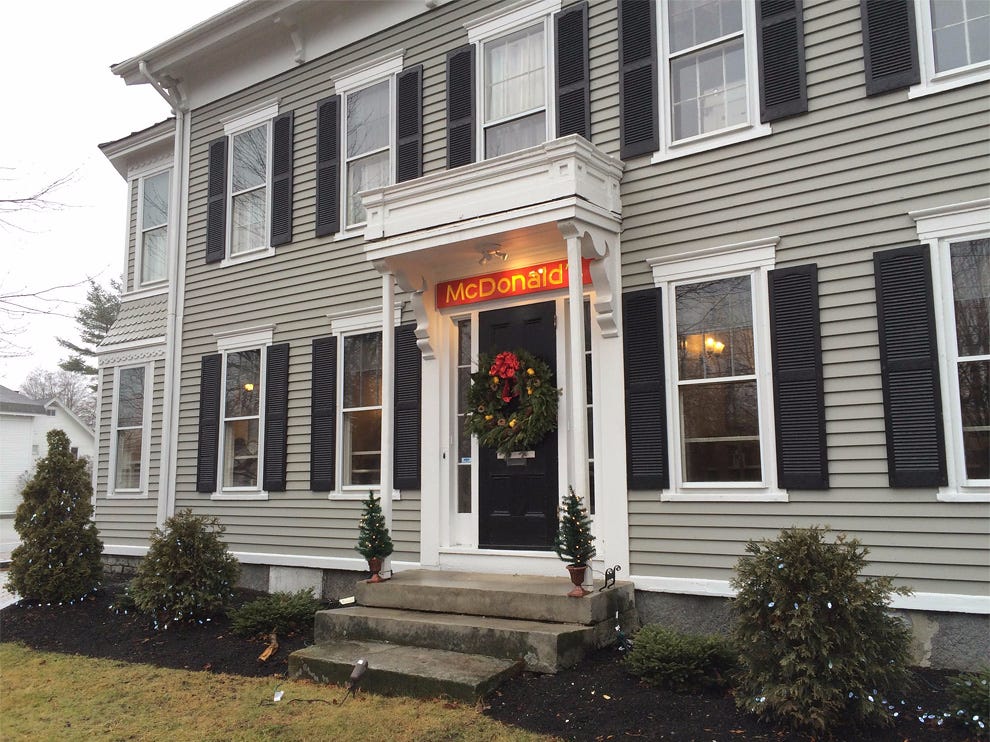
- The final thing we wanted to improve was the aesthetic of these franchise buildings and how they fit into our small towns. By requiring commercial franchise companies to renovate and inhabit old buildings we address this aesthetic issue. In journal 8 I use the example of a McDonalds in Freeport Maine, this McDonalds was required by the town to renovate an existing building rather than build a flashy new one. See the example below.
Who Makes These Decisions?
These decisions should be made by the town as a whole, the people should decide whether a franchise can come in and build a new building. In the decision, the town should be made aware of the large ecological footprint of building these new franchises, as well as the waste they will continuously produce in the future.
Continued the town should also decide how far to eliminate single-use plastics. For example, my home town of Blue Hill, Maine, eliminated plastic bags all together last year. As a town, we voted and decided that all plastic bags will no longer be allowed in Blue Hill. Plastic was replaced by paper bags and customers were encouraged to bring there own bags for groceries and such. This could be further improved by also eliminating plastic cups and all single-use non-environmentaly friendly foodware.
Costs and Financial Gains of Renovation
Another benefit for the franchise is the money that can be saved by renovating an old building vs creating a new one. In an article by The Business Insider, McDonalds reports.. “Startup costs, which include construction and equipment expenses, average between $958,000 and $2.2 million, according to McDonald’s. The total is determined by the geography and size of the restaurant, as well as by the selection of kitchen equipment, signage, style of decor, and landscaping, the company says.”(Article1) While this cost also considers the necessary equipment for making the food, a large percentage of that amount goes into actually constructing the building. Another article by Sweeten Stories, reports that… “Building Journal puts the national average cost for a 5,000-square-foot restaurant with mid-level finishes at $160 a square foot, or $480,000.”(Article2). You can see how renovations can be a lot cheaper for the company as a whole. While we would have to take the cost of purchasing the building into account, we can still see savings of 300k-1.5Million by renovating rather than buying new.
Bibliography
The Business Insider, Article 1: HERE
Sweeten Stories, Article 2: HERE
Renovation vs New construction: HERE
Business Insider, the Freeport McDonalds: HERE
Blue Hill banning single-use plastics bags: HERE
You must be logged in to post a comment.