The dangers of corporatization, conglomeration, and capitalization of technology in big tech and the industrialized global economy is one of the topics I am personally most interested in. Before I was into politics and the real world I was a nerd, ripping Shrek 2 and Halo: Combat Evolved on my Windows 98 PC and getting into design, media, and technology. As I got older I got a bit more involved in the classics and less gen Z pro-gamer activity.
However, I believe these two worlds have met, amalgamating the political interest of market domination and economic interest of constantly raising the bottom line into a tech market that is increasing rapidly in size, capital flow, and energy and time consumption. A political podcast I regularly listen to often describes the new global economy as no longer driven by the petro-dollar or petro-currency but the data-dollar or data-currency. The market cap, liquidity, and corporate interest into social media is unbelievably massive, dwarfing almost all other markets. The overwhelmingly important aspect is data. The data stream collected from users is never ending. Your algorithm may alter or ‘complete’ but as long as users are interacting the data keeps flowing. Unlike oil, data is not a finite resource and that screams of endless revenue to corporate entities.
Believe it or not. Whether you’re pro-capital or not. THIS IS a BAD thing. (In the most reductionist, non-descript terms possible)
The initial dangers and negative effects of social media from too much screen time, dopamine addiction responses to digital community, self-confidence and anxiety issues, or ‘real life’ social interaction deficiencies are magnified by capital greed and corporate interest. More and more we are seeing, “…the actual implementation of these techniques and devices is likely to be quite different – to be used to reduce well-being because a population in a state of fear and anxiety is a far more malleable and profitable population.” as Judith Donath, author of “The Social Machine, Designs for Living Online” puts it.
How does this pertain to me? I am somewhat poor, not a corporate monopoly member, AND I use social media regularly, probably to my detriment.
Donath, quoted in the PEW Research Center article, “The Future of Well-Being in a Tech-Saturated World” argues that not only are there physical and/or mental health implications from the overuse and over-reach of social media apps and tech, but that their creators know that to be true, choosing not just to ignore the dangers of their product, but the embrace them as the most profitable model of control and social media implementation regardless of ethics.
The PEW article offers up a tech survey, questioning “Over the next decade, how will changes in digital life impact people’s overall well-being physically and mentally?” 1150 experts took the survey, of which only 21% of them said that there’d be little to no change, 47% chose ‘more HELPED than HARMED’, while 32% chose ‘more HARMED than HELPED’. While ‘more HARMED’ is a minority it’s still a staggering number. However, it’s not all doom and gloom. As when the same respondents where asked “Do you think there are any actions that might successfully be taken to reduce or eradicate potential harms of digital life to individuals’ well-being?” a staggering 92% responded ‘Yes’.
Although, those actions need to be taken early and effectively. Unlike politics, tech moves fast, therefore the benefits and dangers that come with it do too, making it much harder to pinpoint and safely regulate the malicious and beneficial aspects of tech. Paul Saffo in the PEW Center article speaks on this, proclaiming the “optimistic internet visionaries of the 1990s were neither naive nor mistaken.” Continuing on to argue that the “…expected future always arrives late and in unexpected ways. We are in for a wild period of disorder, but beyond is a sunny upland.” I personally resent that notion. We are in for a wild period of disorder, but it is one predated by artificial, created dangers not unavoidable natural consequences. We know that the “massive and undeniable benefits of digital life…” and “…access to knowledge and culture – have been mostly realized.” as Robert Reich states. (PEW Article) However, Reich then goes on to point out that the negative aspects are just coming to light in the past few years, many of them being defined by corporate interest.
A quote from the PEW article states that Reich is mainly “…worried about corporate and governmental power to surveil users (attendant loss of privacy and security), about the degraded public sphere and its new corporate owners that care not much for sustaining democratic governance.”
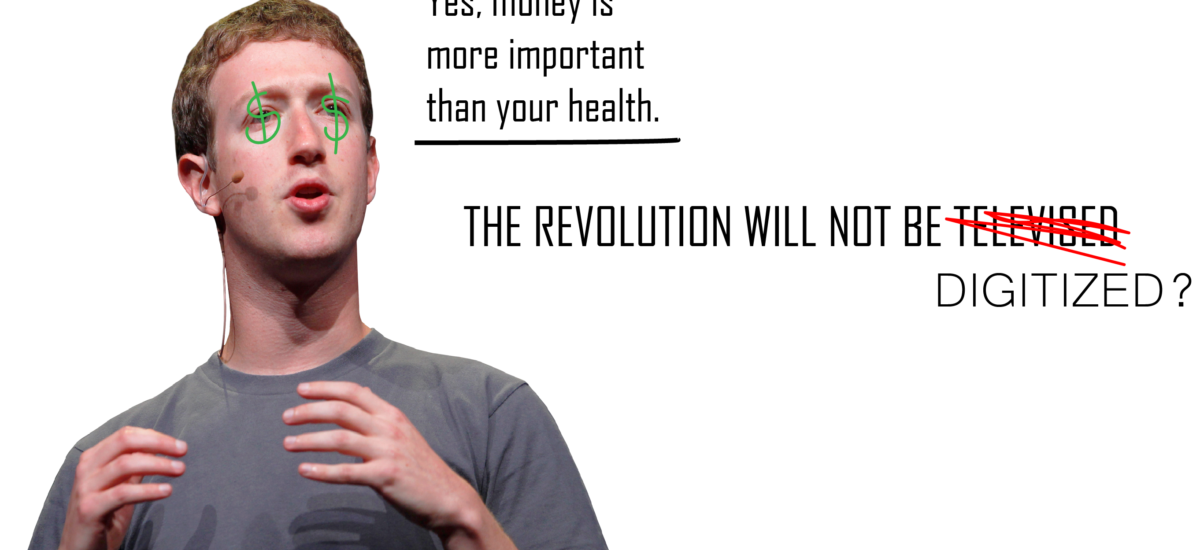
So how can we address this? Not just the dangers of digital interaction, but the blinding political and economic interests that supersede the “good” and “bad” uses or interactions with tech. Unfortunately the answer is quite plain, but not so simple in implementation. As author Kate Thomas remarks in the PEW Center article, “As long as profit is more important than people, digital life will only grow more destructive.” At its core social media and its malicious effects are in hyperdrive, fueled by the greed of those that knowingly and shamelessly put profit above people. Instagram knows it needs to keep teens engaged for hours a day and at meteoric rates compared to pre-pandemic interaction. Facebook or Meta knows it will keep engagement higher if it pushes certain political narratives inequitably compared to their actual trending or post rates. These companies are aware of their actions and the fact of the matter is it doesn’t really matter to them.
Finally, as Dewayne Hendricks, CEO of Tetherless Access argues, under “cyber monopolies”, “… individuals for the most part…” will have “…less control as time passes.” We are, as we often do, going to need greater focus, discussion, and ultimately legislation or ruling on social media. As an extension of our public spaces, a tangible and ‘real’ place, social media can not be approached as fun, free community engagement. When it quite literally is overtaking our world as the most common form of communication in our social lives. We must take the fight to them, and as ‘the product’ take back our digital labor, making social media and tech safe, more egalitarian and equitable, and less predatory. From the FCC with the telegram to US Congress with Meta, attention and change is constantly required to regulate the oversteps of new media.
Thank you for letting me rant!
You must be logged in to post a comment.