(1). Name two aspects of Princess Mononoke which you feel are particularly successful (or not), and explain how and why they work (or don’t). Use one full paragraph for each. Try to focus on aspects that might be particular to anime if you can.
Two aspects of Princess Mononoke I find successful while also being characteristic of Ghibli movies and anime in general were the background art and magical elements.
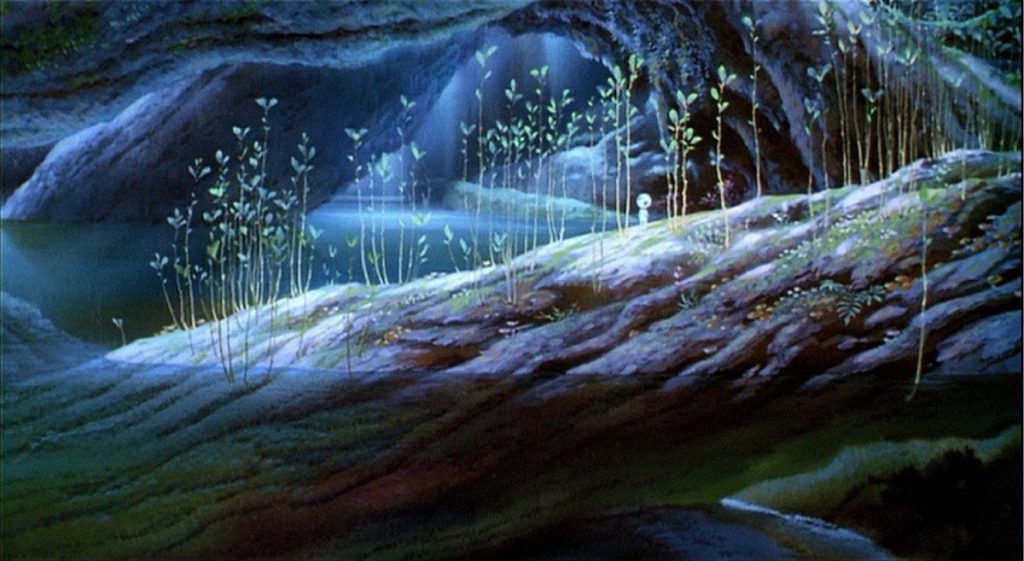
First off, the scenery is breathtaking. One thing I love the most about Japanese animation is the amount of beauty and detail that goes into crafting the scenery; when you see it, you immediately recognize it as being a place straight from an anime film. Princess Mononoke has especially beautiful scenery, my favorite being the forest – the meticulous art coupled with magical elements give it a very whimsical mood. Since setting is often a major component to storytelling, I find that here, it is particularly effective. Being able to see the magical places the characters travel to and live in gives us a better sense of their world and allows us to fully immerse ourselves in it in ways that other media can’t – live action movies, I suppose, could create a similar effect, but there is something to be said about the power of visual art.

The other aspect that stuck out to me, the magical elements, also did well in establishing the kind of world the characters live in. I found different creatures such as the forest spirit and akudama particularly fascinating. Studio Ghibli mastered the creation of these unique creatures, a skill they employ in many of their other films. The forest spirit, who elegantly juxtaposes life and death, leaves viewers in awe of its beauty, while creatures like the akudama might make viewers a bit uneasy at first with their hollow eyes and bobbling heads. Additionally, there is often a sense of spirituality, which I feel especially pertains to Ghibli movies, and I think it is probably the most alluring feature about them. There’s this sense of order amongst the chaos (which I see especially in the forest spirit’s decisions regarding who to let die and live) and destiny, especially for Ashitaka, who we can argue is destined to bring peace to the warring tribes. These factors create a higher purpose in everything that happens in the story, which is an element I find works particularly well. These aspects are born from magical elements in the story, such as the wise woman’s prophecy/fortune she read from the stones, and of course, the forest spirit’s actions.
(2). Reflect on the Princess Mononoke analysis. List two techniques or choices that you would consider using in your own anime story. Explain how they work and why they interest you. Two short paragraphs.
From the techniques listed in the analysis, I really liked what Thompson pointed out about fluid plot and characters with multiple sides.

After the opening scene that sets the tone for the movie, a few major plot points occur simultaneously. Prince Ashitaka fights the boar god Nago, which results in his curse and the wise woman’s order to leave his village. No time is wasted before establishing this; the bare minimum of an exposition is given before the major disruption occurs. In this event, the core theme of the movie is inrtoduced. I like the concept of starting a story in the midst or beginning of conflict rather than in fluff or filler details. I find it’s more engaging this way and doesn’t leave the audience bored and questioning why they’re consuming the story in the first place. I also think that if the plot would feel stiff and forced if it had been executed point by point, and it taught me to think of plot as something a bit less rigid; I think this will free my mind and help me in the future. I guess the only thing to keep in mind with this is to establish key parts of the plot clearly, even when several important events intermingle in a short period of time. Otherwise, the audience might become overwhelmed and confused.

As with the majority of the characters in this story, Lady Eboshi can’t really be classified as a villain nor a hero. At first, it may seem that she is supposed to be a villain due to her violent nature, but as pointed out in the analysis, she is caring and protective of the girls in Iron Town. This goes for almost all characters; there is an opposing force that they are at odds with and a group they are associated with that they want to protect, the exception being Ashitaka. This distinction highlights the theme, and I think it was a necessary choice to portray a lot of the characters with complex morals – this makes them seem more human, and reminds us that there is really no good guy or bad guy in war, just in-groups and out-groups. I’d love to incorporate characters that are more complex like this into my own story ideas. It’s frustrating to deal with characters that seem to have only one side to them, or one set belief system. I think there is better potential of the audience relating to or even just understanding the characters if they contradict themselves like humans do.
(3). What parallels do you see if any between the “war” in Princess Mononoke and in our own country at the moment. Does the film offer any advice that might be helpful to us?
Just like I mentioned in my last point, there are no true heroes or villains in Princess Mononoke; rather, just living beings with different goals, desires, and beliefs. I think this reflects the real world as well; for the most part, no one is really good or bad, just different from one another, which evidently creates conflict. This is a very strange and confusing period of time to navigate with all the pandemic has brought, and to top it off, stances on our current president are very divided with the presidential election just around the corner. Now as well as in history, people who oppose each other often hate each other blindly without really understanding the other’s point of view, even in smaller-scale situations. If everyone could internalize the phrase “see with eyes unclouded by hate” and work hard to learn how to do so, this world would be a vastly different place, and for the better at that.

You must be logged in to post a comment.