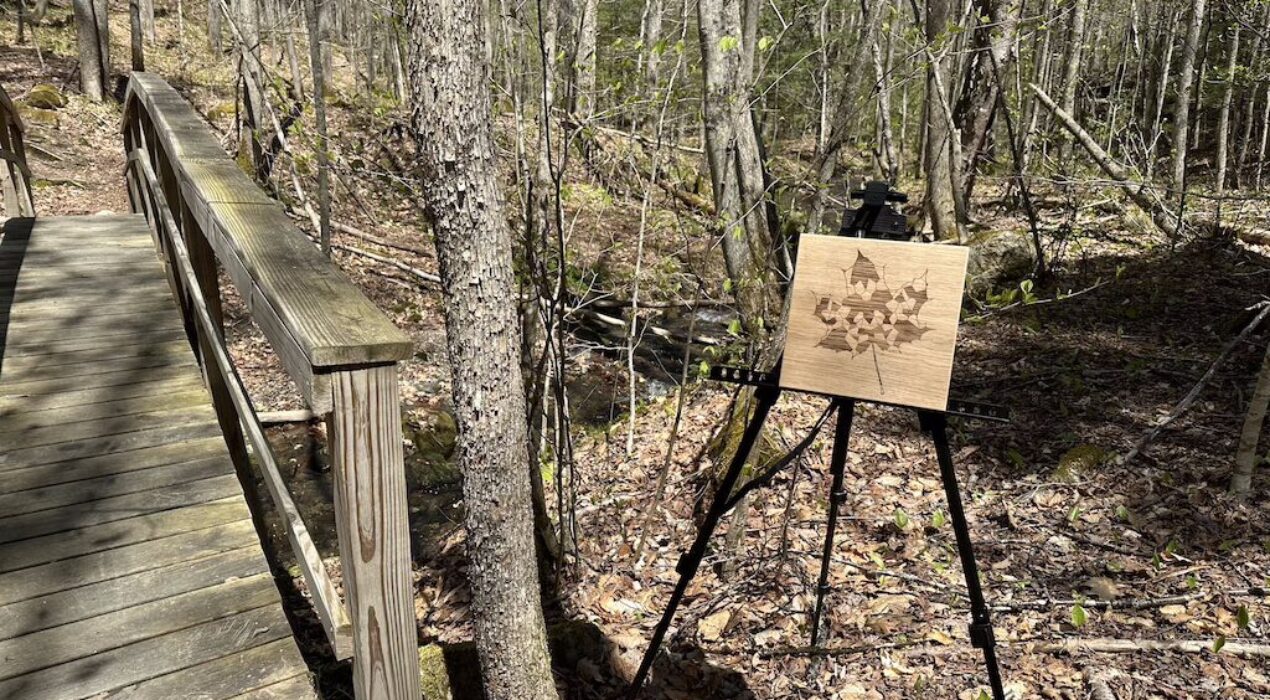
Entangled Ecologies is an augmented reality (AR) interpretive prototype for Smith Pond Shaker Forest in Enfield, New Hampshire, developed as an NEH-supported digital/public humanities prototype project. Working with John P. Bell, Damiano Benvegnù, Yadina Clark, and project partners connected to the site’s history, ecology, and public interpretation (Abenaki historians, Shaker Museum experts, Upper Valley Land Trust stewards), I helped shape a cross-disciplinary experience that invites hikers to encounter the forest as a living archive of glaciers, trees, water, weather, and human history. Through site-based video, photography, audio, and AR overlays, the prototype reveals how the landscape has been shaped over 15,000 years—from retreating ice and forest succession to Abenaki relationships with the Kwanitekw/Connecticut River, Shaker waterworks and craft traditions, storm events, chestnut blight, climate change, and contemporary stewardship. Rather than treating nature and culture as separate stories, the prototype invites visitors to see trails, ponds, trees, dams, and artifacts as interwoven traces of ecological and human memory. My contribution focused on the creative and ecological design of the experience: developing the regenerative framing, shaping interpretive scripts, connecting forest, watershed, climate, and cultural histories, and helping translate complex place-based research into an immersive public encounter. An example of the completed prototype […]
Read More ›
Interactive performance among 20 artists and natural reversing fall in Sheepscot Maine exploring ways to re-connect to living networks in our local bioregion.
Read More ›
Indigenous Culture, Permaculture, Digital Culture LongGreenHouse, UMaine’s first Wabanaki/Permaculture Center operated a “communiversity” linking Wabanaki LongHouse Elders gkisedtanamoogk and Miigam’agan, UMaine’s Still Water Lab and Permaculture courses, the Wassokeag K-12 school, and community workshops. Formed in 2004 as a cross-cultural partnership for regeneration of cultural and ecological networks, LongGreenHouse wove together indigenous culture, permaculture, and digital culture exploring synergies and cross cultural collaboration in the spirit of gratitude and reparation to local Indigenous people upon whose lands we live and thrive. Together we developed a Living/Learning model for thriving cultures in the Gulf of Maine bioregion based on the intersection of evolutionary wisdom, natural patterns, and social networking. LongGreenHouse housed and supported the Wassookeag School, based on an experiential and ecological curriculum; operated a Permaculture research lab for UMaine graduate and undergrads; developed and implemented protocols for Longhouse living in partnership with Wabanaki elders; and developed global social networks with state-of-the-art network technologies. In partnership with MOFGA, we also created the Still Water Permaculture Guild to support a Permaculture Journeyperson program inviting UMaine grads and undergrads to live on site and participate in the permaculture “communiversity”. Founders of the project include StillWater co-directors Joline Blais and Jon Ippolito, gkisedtanamoogk and Miigam’agan, and Debbie […]
Read More ›
From 2007 until 2014, our family was part of the design, development, building and living in the Belfast Ecovillage. As co-founders, we helped design our net-zero “passiv-haus” homes, learned skills for local governance, shared permaculture and farming techniques, made music, fun and food together. We still maintain friendships with current members.
Read More ›
Gratitude Our whole way of Life is one continuous Song, one continuous Ceremony. The way we move is a dance. Ceremony is Life itself. It is the way we do things. Ceremony, to us, is the daily Life; everything we do, everything we think about is all part of that same expression…and we are thankful for it. –gkisedtanamoogk, Wampanoag Colonization All humans are, or have been, indigenous to a given place at one time. Colonization is the process of civilizing indigenous people. To civilize means to break kinship bonds between people, and to sever their ties to the land and all of its beings; To civilize is to break natural networks of interdependence and replace them with violent hierarchies of control in order to centralize power and wealth. Ceremony Request for Ceremony elicits, distributes, and records some examples of Ceremony generated by people attempting to practice or re-activate their kinship with the Beings of Creation, and to remember or reconnect to their Home. Each entry in Request for Ceremony includes a greeting which locates the contributor (character) and their relation to those already part of the local mesh (contact), as well as a description of the ceremony, location with map, […]
Read More ›
What do electronic and indigenous networks have in common? What does sovereignty mean outside of nation-states? How can we build networks of trust in the 21st century? The Cross-Cultural Partnership working group has brought together artists, scholars, and activists from over a dozen indigenous and developed nations for the purpose of answering questions like these. Its ongoing mission is to envision a legal and cultural framework for sharing connected knowledge in a way that is responsible and sustainable.
Read More ›